Getting There
Eight Hours in a Cargo Bay
You reach McMurdo from Christchurch, in the back of a ski-equipped Hercules, sitting sideways on red webbing among the freight. There are no windows to speak of. Everyone wears the issued parka and the issued boots and carries the issued bag, and for eight hours nothing happens at all.
Then the ramp comes down onto sea ice and you are standing on the frozen surface of McMurdo Sound, several miles from anything, waiting for a vehicle. The vehicle, more often than not, is a Delta — an articulated flatbed on tyres taller than a person, built for a surface that will not tolerate anything narrower. The road into town is marked with flags, because in a whiteout the flags are the only thing there is.
The Station
A Mining Town That Does Science
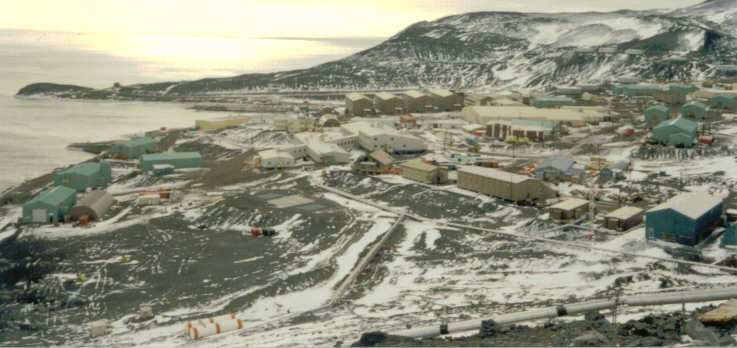
McMurdo is not a research station in the way people picture one. It is a small industrial town — fuel tanks, a power plant, a water plant, a garage, a galley, a store, a chapel, a fire department, and dormitories — that exists so that a much smaller number of people can do science somewhere else. In summer it runs to a thousand people. Over winter it drops to a couple of hundred, and the character of the place changes entirely.
Housing ranges from dormitory blocks to a row of arched huts. The best-known block is the one everybody called the 9-Pack — and that is not slang; it is printed on the station plan. Rooms are small, shared, and warm. The galley runs on a posted schedule and everyone works to it.
Everything arrives by ship once a year. The vessel comes in behind an icebreaker that has cut a channel down the sound, ties up at an ice pier, and unloads a year of food, fuel, vehicles and freight in a few days. Everything that leaves goes out the same way. Waste is sorted into categories stencilled on the side of the containers — burnable only — decades before that was normal anywhere else.
On the station plan. A 1990 building register survives among these papers: every structure numbered and given a function. It is a plain document and a wonderful one — 1 Science Facility · 75 Gym · 155 Galley · 133 Communications and Computer Maintenance · 187 Aquarium · 191 Logistics, Cargo, Materials and Personnel — and, listed separately at the bottom, two buildings on Black Island.
The Work
Writing Code at the Bottom of the World
The job was programmer and senior analyst for the National Science Foundation, supporting a wide range of science across the continent. In practice that meant a room of beige computers in the Crary Lab, and a system that tracked where every person and every pallet in the United States Antarctic Program actually was.
That sounds mundane until you consider the consequence of getting it wrong. A field camp expecting a fuel drum that went to the wrong coordinate is not an inventory discrepancy; it is a problem with a helicopter and a weather window attached to it. The second workplace — the IT building next to the heavy equipment shop — held the shelves of technical manuals, the spares, and the phone.
The other long thread was communications. McMurdo has a mountain in the way of the satellites it needs, so the link runs across the sound to Black Island, forty-odd miles off, where a small unmanned site full of antennas and radomes does the talking. Getting there meant a helicopter, and the route across the shelf had to be flagged by hand before anybody could drive it. Everything the station sent or received — the science data, the logistics traffic, and eventually the internet — went through that hill.
The webcams are still running. They were set up for an Earth Day event — the organisers wanted a live camera on every continent, and Antarctica was the one nobody had. Those cameras, and their descendants, are still pointed at the same hills today, and anyone can look at them on the USAP site. Thirty years later I stood in front of a bank of the same feeds at the
International Antarctic Centre in Christchurch, which was a stranger feeling than I expected.
The Dark
Four Months Without a Sunrise
The sun sets in late April and does not come back until August. What people get wrong about the polar night is the idea that it is uniformly black. It is not. There is a long blue twilight at either end of it that goes on for weeks, and in the middle of it the moon does a full circuit without setting, and the snow takes the colour of whatever light there is.
A wintering station invents its own calendar, because otherwise there isn't one. Midwinter dinner in June is the fixed point everything else hangs off. There is a chili cookoff, judged with more solemnity than the entries deserve — team banners in these photographs advertise Road Kill Chili, Haz Mat Chili served off the tailgate of a truck, and the Cool Chili Cantina, promising the hottest chili at the coldest place on earth. There is a parade of vehicles carrying snow and ice sculptures through the dark, which is precisely as strange and as good as it sounds. There is a band, and the band plays.
On the Fourth of July a party walked up Castle Rock in the dark, on the flank of Erebus, and set off flares. The route out has emergency shelters spaced along it, small and red and unmistakable, because the weather here changes faster than a person can walk.
Then the light comes back. The first sunrise after four months is an event with an audience, particularly for anyone who has been working nights, and the sky puts on lenticular clouds over Erebus that look like nothing else on earth.
The station papers. Winter-overs published their own newspapers, and they are exactly what you would hope: Dark Star — "McMurdo's Own Rag", The Quick Brown — "All the news that's left to print", and the more official Antarctica Sun Times, "Published for the Frozen Chosen." One 1992 issue carries a letter of thanks to everybody who went out onto the shelf to flag the route to Black Island. Another explains that the Navy Seabees are known as the Men in Green, after the greens they work in — which is the sort of detail you only get from a paper written by the people it is about.
Out of Town
Huts, Ice, and a Frozen Seal
Before anyone goes into the field they go to snow school. You learn to build a wall against the wind, then a shelter, then you sleep in the thing you built. It is a genuinely good course, and the part everybody remembers is not the theory but the moment the wall is high enough to stand behind and the wind stops.
Two miles from the station, on the point, is the hut Scott's Discovery expedition put up in 1902. It is still standing, still full of their supplies, still cold enough to have preserved them. Beside it is a wooden cross, and the inscription is legible today: Sacred to the memory of George T. Vince, AB RN, of the Discovery, who was drowned near this spot, March 11 1902. He slid off the edge in a blizzard. The cross has been there ever since, two miles from a town of a thousand people, which is a fair summary of what this place is.
Two miles the other way is Scott Base, the New Zealand station — green buildings, a signpost giving the distance to everywhere, and a bar. Relations between the two stations are warm and the traffic is mostly one-way, for a reason that will be obvious to anyone who has drunk both countries' beer.
Further out, the Dry Valleys: ice-free, wind-scoured, one of the driest places on the planet. Somewhere on the way there we came across a seal that had wandered inland, died, and been freeze-dried instead of decaying. They have been doing that for centuries here. Nothing rots; it just waits.