November 1994 · Queensland · Great Barrier Reef
Australia
A year in a frozen food locker, then three hours across the Tasman to a hundred degrees, a dive boat on the outer reef, and seven dives in three days.
Scroll ↓
A year in a frozen food locker, then three hours across the Tasman to a hundred degrees, a dive boat on the outer reef, and seven dives in three days.
After a year of living in a frozen food locker, the thing you want is somewhere warm. For a great many of us that somewhere was Australia.
Once you leave the Ice the military gives you a plane ticket home. These are Category Z tickets — open-ended, and essentially indifferent to the route. Nobody much cares how you get home. They just want you to go. Which means that even for those of us planning to stay a while in New Zealand or Chile, the ticket becomes a licence to travel the long way round the world. One man I knew went off into Russian Siberia. A couple ran a camera safari ranch in Mozambique. One of our Navy commanders led hiking tours in Nepal.
Australia is the natural first choice, being only three hours across the Tasman, and it is also a chance to get used to ordinary society again. You relearn that you have to pay for the petrol after you pump it, and that a restaurant will not only cook your food but carry it out to you.
The certification came first, and it came in cold water. At the Pole the hot-water drill crews working the neutrino strings doubled their rig as scuba practice; the open-water checkout dives were done properly afterwards, off the shore at Akaroa on Banks Peninsula, in the second week of November 1994.
Four dives over two days. Sixty-two degrees Fahrenheit, one to three metres of visibility, fifteen minutes on the bottom at a time. The logbook for the first one reads, in full: First scuba dive. Very poor visibility. Nine days later the same logbook would be recording eighty-seven degrees and thirty feet of visibility on the other side of the Tasman, which is as good an argument for Australia as anyone has ever made.
Sydney and Melbourne are both very exciting places to visit, and both were on the way. The great Sydney Opera House, where a friend of mine was married. The food in Melbourne, which is as good as anyone tells you it is, and where — on the far side of the world, with no arrangement whatever — I walked into a couple of old friends from Colorado.
Almost none of it was photographed. What the camera got was the far north.
My friend and I flew into Cairns and found a hotel room with an air conditioner as fast as we could manage it. Moving from twenty below to a hundred above in a matter of hours is a genuine shock to the system, and not a metaphorical one.
Cairns in 1994 was a working port town that had recently discovered it was also a resort: the Esplanade along the mudflats, coconut palms, white colonial buildings across the road from the water, a marina full of boats that all went to the same place. Wet-season showers came through in the afternoon and dried off the streets within the hour.
We booked a dive boat out of Cairns — the kind that takes you out into the Great Barrier Reef and keeps you there, so you get in as many dives as you can stand. It is basically a floating hotel with a tank rack on the back deck.
The cook would ask us to help devein shrimp and prepare the evening meal, which seemed a fair trade for the berth. The leftovers went over the side afterwards, and a group of blacktip reef sharks would come in and circle the stern like puppy dogs waiting for a handout. This is the way to see the reef — dive, eat, sleep, dive again, day dives and night dives, with nothing in between but the water.
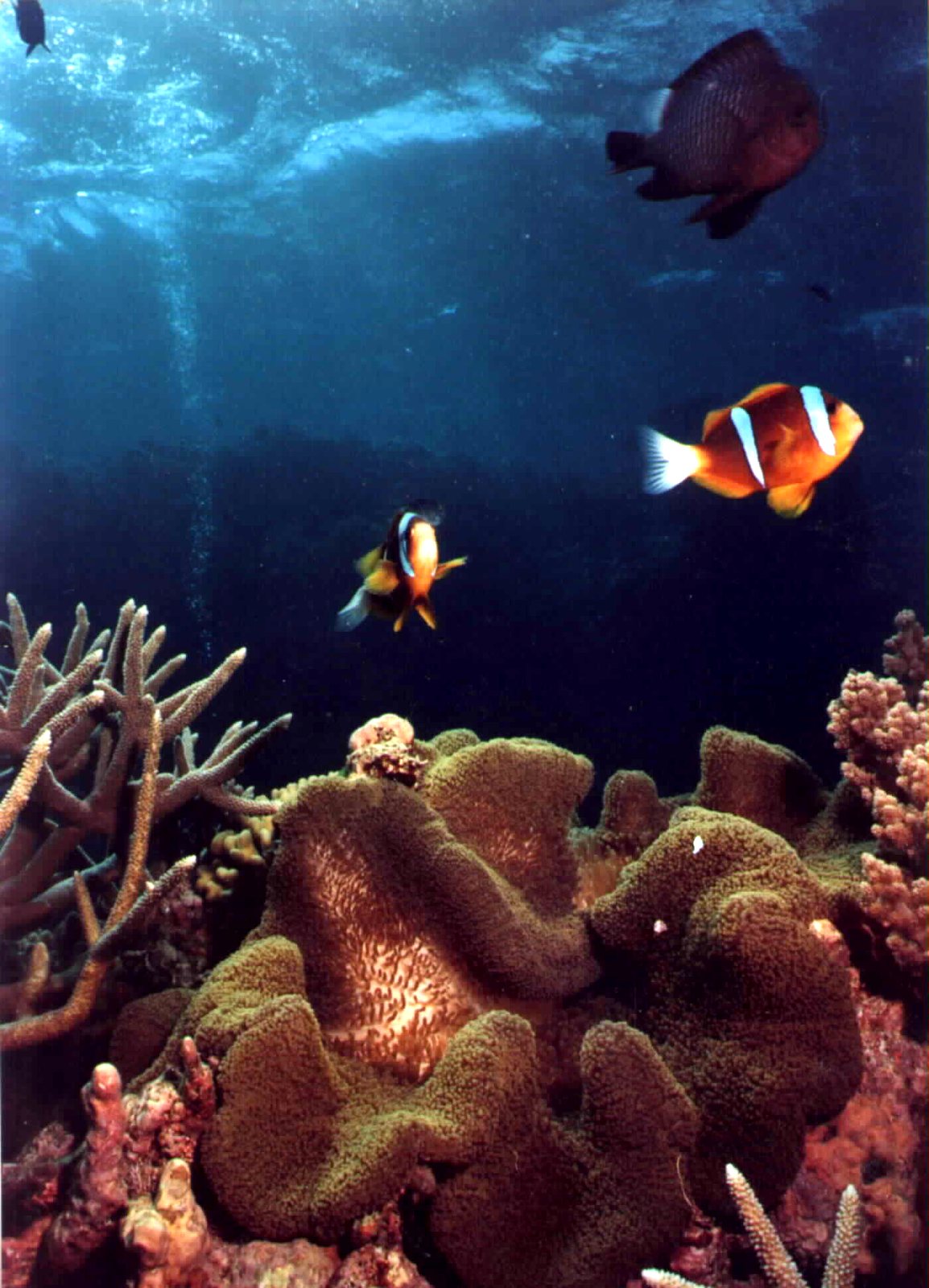
The reef is the largest living structure on the planet — some 2,300 kilometres of it, nearly three thousand individual reefs, visible from orbit, and a World Heritage area since 1981. From a dive platform off Cairns it is simply the clearest, warmest, most crowded water you have ever put your face in.
Michaelmas Cay first, in five metres, for the first reef dive of my life. Then the outer reef the same afternoon, deeper, with coral heads the size of rooms and reef sharks moving along the edge of visibility. Moore Reef and Briggs Reef over the following two days, one of them at half past six in the morning with the light still coming up. I got close to a sand shark, which is a thing you do once and remember for thirty years.
One day we took a side trip out to Fitzroy Island, a continental island inside the reef about an hour off Cairns on the Great Adventures catamaran. You come in along a timber jetty to a board with the day's programme chalked up on it: guided snorkel tours, diving tours, adventure snorkel boat, the island walk.
The island is a drowned mountain rather than a coral cay — rainforest to the waterline, granite boulders, a fringing reef you can swim to from the beach. It is also the easiest place in the region to meet the local wildlife without going looking for it.
Next on the list was the Daintree — another World Heritage area, and the oldest continuously surviving tropical rainforest on earth, something like a hundred and eighty million years of it. The road north out of Cairns runs along the edge of the Coral Sea with the forest coming down to meet it, which is a drive worth doing for its own sake before you have arrived anywhere.
You take the river cruises and the rainforest walks. You read the signs, which are not decorative: estuarine crocodiles inhabit most rivers, swamps and lagoons throughout Cape York Peninsula. And the best of it, up in the hills where the creek runs over bare granite, is a natural water slide — you sit down on the rock and go down it into a pool.