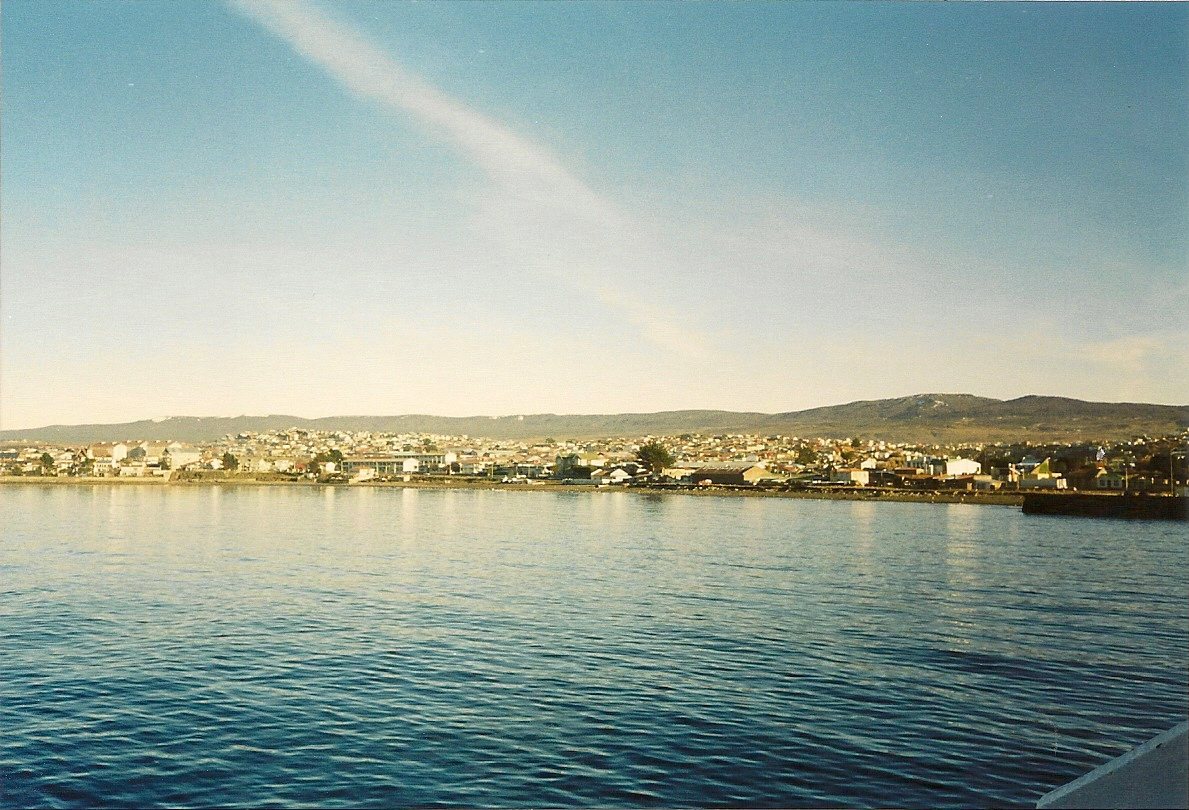
1996 · Magallanes · Strait of Magellan
Punta Arenas
The town at the bottom of Chile where every trip to Palmer Station began — the Polar Duke at the pier, seven-metre seas in the Strait, and a plaza with Magellan on a pedestal.
Scroll ↓
The town at the bottom of Chile where every trip to Palmer Station began — the Polar Duke at the pier, seven-metre seas in the Strait, and a plaza with Magellan on a pedestal.
Christchurch is the jumping-off point for the Ross Island stations — McMurdo and the Pole. Punta Arenas is the jumping-off point for the peninsula, and for Palmer Station in particular. Getting there is its own expedition: Miami, then Santiago, then a domestic flight the length of Chile to the Strait of Magellan. All told it is about the same distance, and about the same number of hours in the air, as flying to New Zealand.
What waits at the end is a working port town of tin roofs and painted houses, laid out low along the water with Tierra del Fuego on the far shore. It is the capital of the Magallanes region and the practical capital of Patagonia — the last place with a hardware store, a hospital and a customs office before the ice.
Punta Arenas is the home port for the two United States Antarctic Program research vessels, the Laurence M. Gould and the Nathaniel B. Palmer. In the mid-nineties it was also where you found the Polar Duke, and the Polar Duke was the ship that first carried me to Palmer Station.
She had a Norwegian crew, and the crew had computer trouble. So naturally they asked the American passenger to fix it — in Norwegian. An interesting adventure, to say the least. The ship's doctor prescribed a healthy dose of meclizine to get me through the rest of the trip.
There is film of it. Leaving Port is shot around the pier and aboard ship — the cargo and the deck equipment, the gangway and the corridors, and the town going astern as we cleared the harbour.
Ship duty ran two months on and two months off. Some rotations were nothing but the shuttle — back and forth across the Strait and down the peninsula, ferrying cargo and passengers to Palmer. Others went far afield; one took us as far as the Cape of Good Hope.
The Strait of Magellan has a reputation, and it earns it. The Atlantic and the Pacific meet in a narrow passage, and the result is seas that run to seven metres. The standing advice on board was to strap yourself into your bunk. Otherwise you might end up on the floor. Will end up on the floor. Just sayin'.
Palmer's seasons were the loose ones. McMurdo waits out the winter storms and the Pole waits until it is warm enough to start an aircraft engine; Palmer is reached by sea, at 64° south, where the light lasts longer and the calendar bends. A normal deployment ran five to seven months, like the other stations, but with far more give in the dates at either end.
The centre of Punta Arenas is one square with Magellan standing on top of a monument in it, a bronze Fuegian at his feet whose toe is polished gold by everyone who has rubbed it for a safe return. Around the square: the Sara Braun palace with its conservatory, the cathedral tower, the customs and naval buildings, and a bank on the corner.
The people have an interesting history. The original peoples of Patagonia were displaced by the Spanish, and then, more recently, by waves of immigration — Slavic families, Germans, and others who came for the wool and the gold and stayed. It is why so many of the children here are blond-haired and blue-eyed, at the bottom of South America.
One morning the whole town turned out in the rain. An army band came down the avenue past the Sara Braun palace with the brass out in front, then the flag party, then the regiments, and then every school in Punta Arenas in turn — blazers, white gloves, sashes, and a banner per school, marching past parents standing between the parked cars with their collars up.
It finished at the monument in the square, with a wreath and a small group of officials standing very straight in the wet. Autumn colour in the trees, everything shining, nobody leaving early.
Punta Arenas sits in the heartland of Patagonia, and Patagonia is a nature reserve the size of a country. The first thing you notice is the contrast: mountains that go up like walls, and plains with nothing on them but wind. The prize is Torres del Paine, north of the town — three granite towers over a glacial lake the colour of milk and copper sulphate.
Our logistics in Chile were handled by AGUNSA — visas, accommodation, ship maintenance, and generally making sure we stayed out of trouble in a country we passed through twice a year. One year I was sent up to their head office in the Las Condes neighbourhood of Santiago to install a piece of software.
That put me in the city for over a week. Santiago has more than five million people and, I am told, very nearly as many buses. Every day the walk took me past the Plaza de Armas and the Iglesia de San Francisco. It was a wonderful trip, and I came home with a good many new friends.
With the software installed, I took a bus out to Valparaíso — a seaside town not far from Santiago, built up the hills in every colour anyone had paint for, with a fine long embarcadero to walk at the bottom of it.